“Lemmatization, also known as stemming, normalizes words before counting them.”
Field Notes
Tips from the field from The CRMLady
-
“Azure AI Services provides direct access to both Azure AI Translator and Azure AI Speech services through a single endpoint and authentication key.
Azure AI Language service can be used to access the Azure AI Language service, but not the Azure AI Translator and Azure AI Speech services.
The Machine Learning service is used to design, implement, and deploy Machine Learning models.
Azure AI Bot Service provides a framework for developing, publishing, and managing bots in Azure.”
Get started with translation in Azure – Training | Microsoft Learn
REGRESSION
“Predicting rainfall is an example of regression machine learning, as it will predict a numeric value for future rainfall by using historical time-series rainfall data based on factors, such as seasons.
Clustering is a machine learning type that analyzes unlabeled data to find similarities in the data.
Featurization is not a machine learning type, but a collection of techniques, such as feature engineering, data-scaling, and normalization.
Classification is used to predict categories of data.”
-
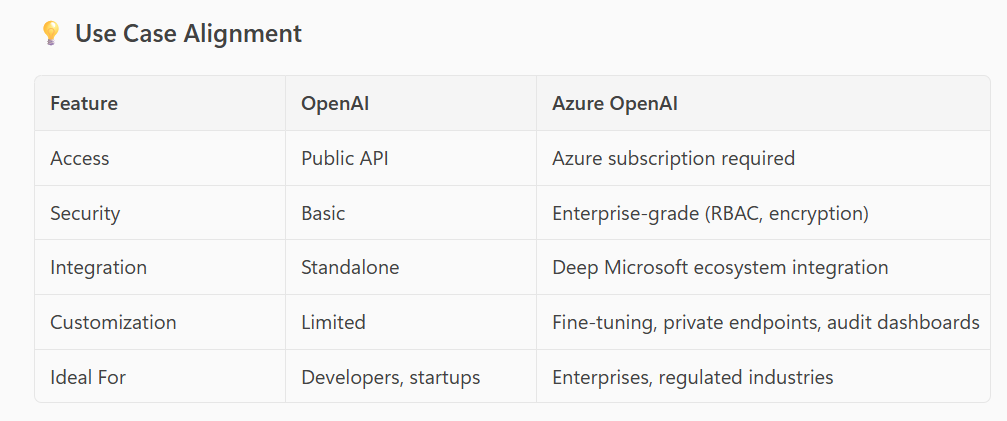
Should you use OpenAI directly or go through Microsoft Azure OpenAI? While both offer access to powerful models like GPT-4 and DALL·E, the differences in deployment, governance, and enterprise readiness are substantial.
Azure OpenAI is a collaborative service between Microsoft and OpenAI, designed for enterprise use. It provides access to the same models as OpenAI directly (GPT-4, GPT-4 Turbo, DALL·E, Whisper and more) but within the Azure cloud ecosystem.
What value does Azure Cloud bring?
Data residency and isolation: Ensures data stays within your Azure subscription
Enterprise-grade security: Role-based access control, encryption at rest, and compliance with Microsoft standards which have passed a large number of global certifications. More details can be found on the Microsoft Trust website. You don’t have to trust Microsoft, you can trust the industry regulation requirements that have been cross verified.
Integration with Microsoft stack: Seamless use across Microsoft 365, Power Platform, Dynamics 365 PowerApps, and Azure DevOps.
So in general consider Azure Open AI that extra layer of control and compliance. It also provides fine-tuning, embeddings, and custom deployment opportunities with an extra set of tools.
If you want more specific use cases this table might be helpful:

-
Observability in the world of Microsoft and AI
Observability
Azure AI Foundry supports Observability using some of the following evaluators:
Groundedness: measures how consistent the response is with respect to the retrieved context.
Relevance: measures how relevant the response is with respect to the query.
Fluency: measures natural language quality and readability.
Coherence: measures logical consistency and flow of responses.
Content safety: comprehensive assessment of various safety concerns.
So my word of the day is Groundedness, mostly because the “word” just jumped out at me as one of those new definitions for my brain, and in general vocabulary has other meanings for the growing generations.
In the Merriam-webster dictionary we find -> “Emotional and Psychological Context
It can also describe a person who is mentally and emotionally stable, realistic, and unpretentious. Someone with groundedness is often seen as calm, mindful, and not easily swayed by external chaos. [merriam-webster.com]”and in Psychology Today we get “Spiritual and Mindfulness Context
Psychology Today defines groundedness as a sense of being fully embodied, whole, centered, and balanced in oneself and relationships. It’s associated with clarity, harmony, and a deep connection to the authentic self. [psychologytoday.com] “So using the term as an evaluator trends towards a new sense of logic as we observe and evaluate AI results.
-
While both offer tools for publishing content online, they differ significantly in terms of flexibility, user experience, and ecosystem. So what are the key differences.
1. Ownership and Ecosystem
- WordPress comes in two flavors: WordPress.com (hosted) and WordPress.org (self-hosted). The latter gives users full control over their site, including custom themes, plugins, and server access.
- Typepad is a hosted platform owned by Endurance International Group. It offers a more controlled environment, which can be appealing to users who prefer simplicity over customization.
2. Ease of Use
- Typepad is known for its straightforward interface and minimal learning curve.
- WordPress, especially the self-hosted version, has a steeper learning curve but offers far more flexibility. The block editor (Gutenberg) has improved usability, but beginners may still find it overwhelming.
3. Customization and Extensibility
- WordPress shines in this area. With thousands of themes and plugins, users can tailor their site to virtually any need—from e-commerce to membership portals.
- Typepad offers limited customization. While users can tweak templates and use some widgets, it doesn’t support the extensive plugin ecosystem that WordPress does.
4. Community and Support
- WordPress benefits from a massive global community. Whether you need help with a plugin or want to hire a developer, resources are abundant.
- Typepad has a smaller user base and community. Support is available via email and forums, but it’s not as robust or active as WordPress’s.
5. SEO and Performance
- WordPress offers powerful SEO plugins like Yoast and Rank Math, giving users granular control over metadata, sitemaps, and more.
- Typepad includes basic SEO features, but lacks the depth and flexibility that WordPress provides.
6. Cost
- Typepad is subscription-based, with pricing tiers depending on features and bandwidth.
- WordPress.org is free, but users must pay for hosting, domain registration, and any premium themes or plugins. WordPress.com offers free and paid plans.
-
It was with sad eyes that I learned that Typepad was no longer a product that I could use. We had an incredibly great 20 years of CRMLady posts, but with technology we have daily changes and as with all previous days, weeks, months and years I also continue to evolve with technologies.
Over the last four months, I have used AI in my daily work. I joined a new company in June and the technology landscape is wide. Continue to grow with me as I learn and share.
 Field Notes